10. Comparing revisions
Every simulation you submit creates a new revision. Compare puts all revisions of a configuration side by side, so you can see what each change did and pick the best design.
Opening the comparison
In the revision bar, click Compare. The Compare Simulations dialog opens:
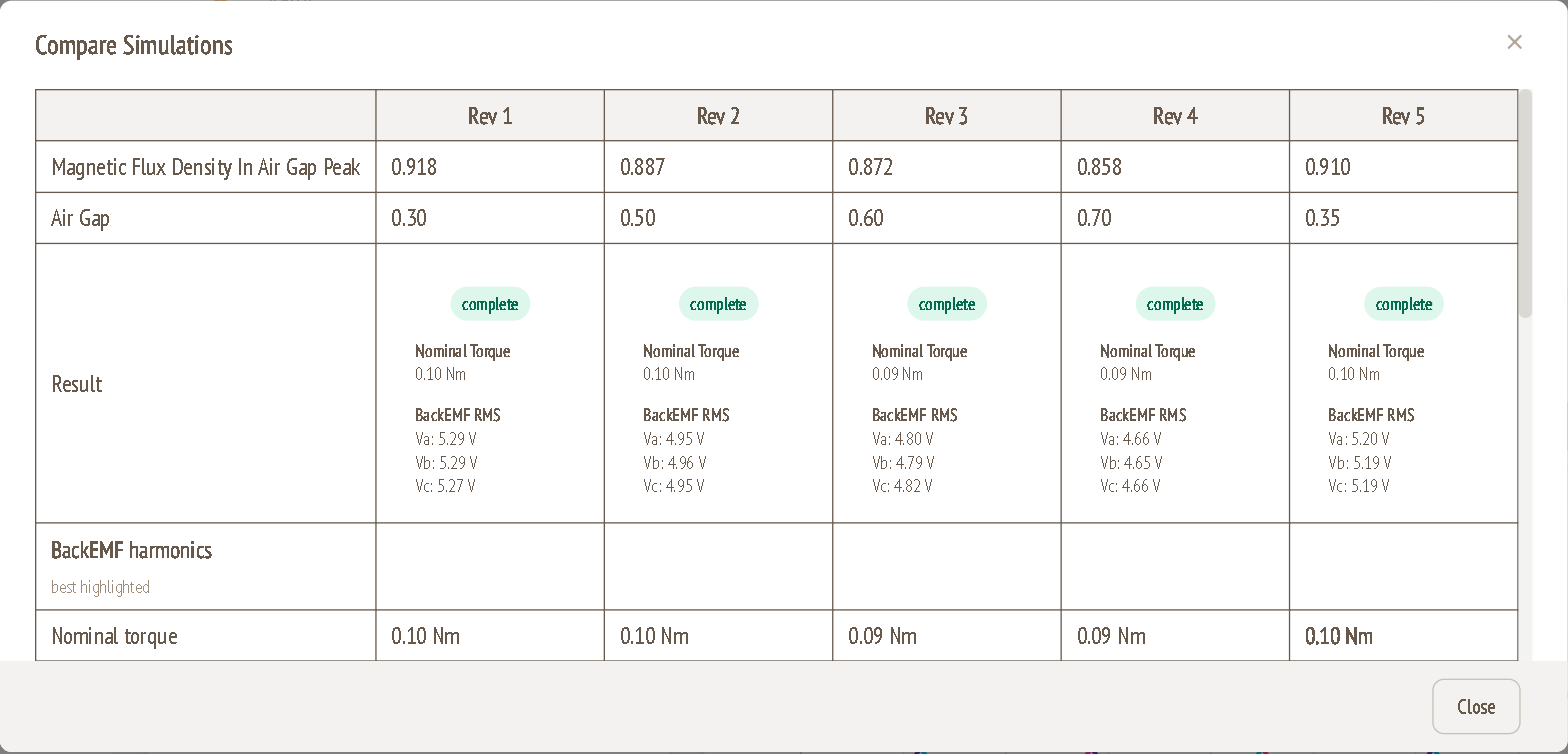
The table has one column per revision (Rev 1, Rev 2, …) and is organised in three blocks. The full table from the example is shown below.
1. Parameters that differ
The top rows list the input parameters that differ between revisions, along with the key analytical results that depend on them. In the example, only the air gap was changed (0.30 → 0.50 → 0.60 → 0.70 → 0.35 mm), so the table also shows the resulting air gap peak flux density (0.918 → 0.858 T).
2. Result
For each revision: the simulation status (complete / error), the nominal torque, and the simulated back-EMF RMS per phase. In the example, the back-EMF falls from 5.29 V to 4.66 V as the air gap grows from 0.30 to 0.70 mm, and the torque drops from 0.10 to 0.09 Nm.
3. BackEMF harmonics (best highlighted)
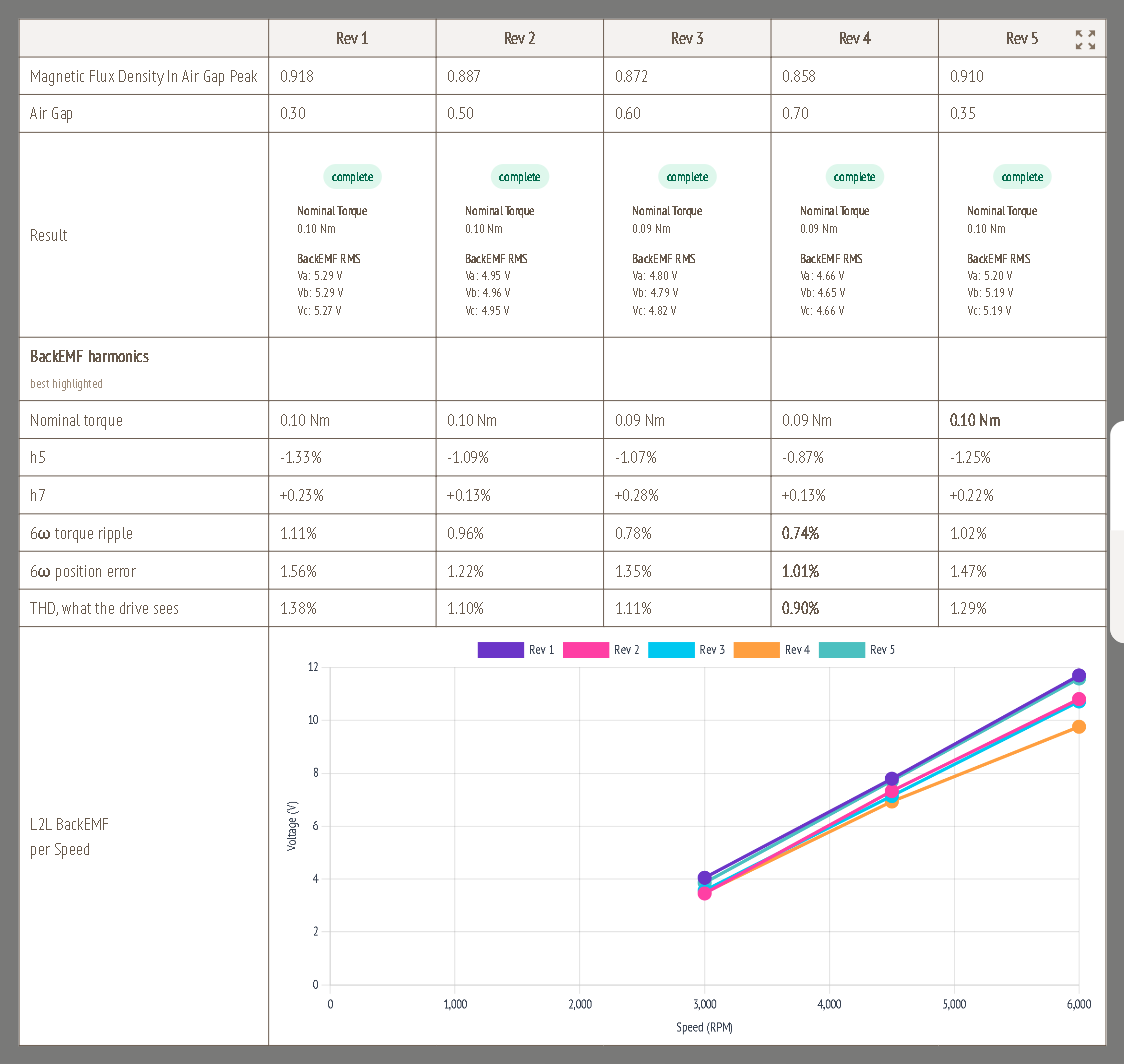
The nominal torque and the harmonic figures from the Harmonics tab (guide 8) for every revision. The best revision is shown in bold in the nominal torque (highest), torque ripple, position error and THD (lowest) rows:
| Row | What it tells you |
|---|---|
| h5, h7 | The raw 5th and 7th harmonics that the two rows below are built from |
| 6ω torque ripple | Smooth torque |
| 6ω position error | Sensorless control accuracy |
| THD, what the drive sees | Overall line-to-line waveform quality |
At the bottom, L2L BackEMF per Speed plots every revision's back-EMF against speed on one chart. A steeper line means a higher Ke.
Reading the example
The comparison shows a trade-off:
- Rev 4 (0.70 mm air gap) has the best harmonics: lowest torque ripple (0.74 %), lowest position error (1.01 %) and lowest THD (0.90 %). But it loses torque (0.09 Nm) and back-EMF.
- Rev 1 (0.30 mm) and Rev 5 (0.35 mm) keep the full 0.10 Nm, with higher but still low harmonic content.
Which is best depends on your priority. If waveform quality matters most, take Rev 4 and recover the torque elsewhere, for example with more turns or a slightly larger diameter. If torque density matters most, take Rev 5. This matches the Harmonics tip: a wider air gap lowers h5 and the ripple as well, at the cost of torque.