Efficiency in Permanent Magnet BLDC Motors
Efficiency in Permanent Magnet BLDC motors, made simple.
MAI 4, 2024
Defining the Efficiency of Electric Motors
The efficiency of an electric motor is the ratio of its mechanical power output to the electrical power input. Because conversions from electrical to mechanical energy often suffer inefficiencies due to heat loss, friction, etc., the mechanical output is always less than the electrical input. In essence, efficiency is the difference between useful output power and input power.
Factors Influencing Electric Motor Efficiency
The efficiency of electric motors is a critical factor in both their performance and the overall energy consumption of the systems they power. Electric motors convert electrical energy into mechanical energy, and this process is never 100% efficient. In a permanent magnet Brushless DC (BLDC) electric motor, various types of losses contribute to a reduction in overall efficiency.
Electric motor efficiency is influenced by a combination of design, operational, and environmental factors. Understanding these factors is crucial for optimizing the performance of electric motors. Here are key elements that impact motor efficiency:
- Motor Design:
- Type of Motor: Different types of motors (e.g., induction motors, synchronous motors, brushless DC motors) have varying inherent efficiencies.
- Magnetic Materials: High-quality magnetic materials in the stator and rotor contribute to reduced core losses and improved efficiency.
- Winding Design: The design and configuration of the motor windings affect copper losses and overall efficiency.
- Rotor Design: The rotor design, especially in the case of permanent magnet motors, influences efficiency and performance.
- Air Gap: The size and uniformity of the air gap between the stator and rotor play a role in minimizing magnetic losses and improving efficiency. To learn more about air gap, you can check out the article on electric motor air gap.
- Size and Load Matching:
- Motor Size: Selecting the right motor size for the application is crucial. Undersized or oversized motors can lead to efficiency losses. Custom electric motors, tailored to the exact requirements of the system, can deliver unmatched efficiency gains.
- Operating Load: Motors operate most efficiently within a specific load range, typically between 60 and 100 percent of their full-rated load.
- Power Factor:
- Power Factor Correction: Power factor measures how effectively electrical power is converted into useful work. A low power factor can reduce motor efficiency, and power factor correction techniques may be employed to mitigate this.
- Voltage and Frequency:
- Voltage and Frequency Matching: Operating the motor at the rated voltage and frequency specified by the manufacturer is essential for optimal efficiency.
- Control Systems:
- Variable Speed Drives (VSD): Using VSDs allows for adjusting the motor speed based on actual demand, optimizing energy consumption and efficiency.
- Advanced Motor Control Algorithms: Smart control systems can optimize motor operation, reduce losses, and improve overall efficiency.
- Environmental Conditions:
- Temperature: Motors may experience efficiency losses at extreme temperatures. Adequate cooling systems are crucial for maintaining efficiency.
- Altitude: Motors at high altitudes may experience reduced cooling efficiency, affecting overall performance.
- Maintenance and Lubrication:
- Regular Maintenance: Keeping the motor well-maintained ensures that it operates at peak efficiency.
- Lubrication: Proper lubrication of bearings and moving parts reduces mechanical losses and maintains efficiency.
- Losses:
- Copper Losses (Ohmic or I²R Losses): Resistance in the motor windings results in the conversion of electrical energy into heat. This loss is proportional to the square of the current flowing through the windings.
- Iron Losses (Core Losses):
- Hysteresis Loss: Energy dissipated due to the reversal of magnetization in the motor core material.
- Eddy Current Loss: Energy dissipated as currents circulate within the motor core in response to changing magnetic fields.
- Mechanical Friction and Windage Losses:
- Friction Loss: Energy lost due to mechanical friction between moving parts, such as bearings and gears.
- Windage Loss: Energy dissipated as a result of air resistance encountered by rotating components.
- Stator Tooth and Core Losses:
- Stator Tooth Loss: Energy dissipated as the magnetic field interacts with the stator teeth.
- Stator Core Loss: Energy lost in the stator core due to magnetic hysteresis and eddy currents.
- Rotor Iron Losses:
- Rotor Tooth Loss: Energy dissipated as the magnetic field interacts with the rotor teeth.
- Rotor Core Loss: Energy lost in the rotor core due to magnetic hysteresis and eddy currents.
- Magnetostriction Loss:
- Magnetostriction: Mechanical deformation of the motor core material in response to changing magnetic fields, resulting in energy losses.
- Stray Load Losses:
- Leakage Inductance Loss: Energy lost as a result of the leakage flux between the motor windings.
- Leakage Current Loss: Energy dissipated due to the flow of leakage currents in the motor.
- Sensor and Control Losses:
- Sensor Loss: Energy consumed by sensors used for position and speed feedback.
- Control Loss: Energy dissipated in the electronic control and drive systems.
- Efficiency Standards:
- Compliance with Standards: Motors meeting specific efficiency standards, such as IE3 or IE4, are designed for higher efficiency levels.
- Advanced Technologies:
- High-Efficiency Materials: Advancements in materials, such as improved magnetic materials and low-loss laminations, contribute to enhanced efficiency.
- IoT and Smart Monitoring: Real-time monitoring and analysis of motor performance can lead to proactive efficiency improvements.
Understanding and minimizing these losses are crucial for enhancing the overall efficiency of permanent magnet BLDC electric motors. Turncircles employs advanced design techniques and materials to mitigate these losses and improve motor performance.
Energy Efficiency Rating of an Electric Motor
The efficiency of an electric motor is typically represented by its efficiency rating, which is given as a percentage. This rating indicates the proportion of electrical energy input that is converted into useful mechanical work output. The remaining percentage is lost as heat or other forms of energy.
Efficiency ratings for electric motors can vary depending on factors such as motor size, design, and operating conditions. Generally, smaller motors tend to have lower efficiency ratings compared to larger ones.
For example, a typical electric motor may have an efficiency rating of around 80%-95%. This means that only 80%-95% of the electrical energy input is converted into useful mechanical work, while the rest is lost as heat or other forms of energy. The specific efficiency rating will depend on various factors, including the motor's design and load conditions.
Efficiency improvements in electric motors are continuously being pursued to reduce energy losses and improve overall system performance. This includes advancements in motor design, materials, and control systems. Higher efficiency motors not only reduce energy consumption but also contribute to reduced greenhouse gas emissions and operating costs.
It's worth noting that the overall energy efficiency of a system also depends on other components involved, such as power transmission systems, pumps, fans, or any other devices connected to the motor. Therefore, optimizing the entire system's efficiency requires considering all the interconnected components and their individual efficiency ratings.
One key aspect of motor efficiency is the relationship between the load placed on the motor and its rated capacity. Motors are designed to operate most efficiently at a specific range of loads. When a motor runs below or above this optimal range, its efficiency drops. In the next section, you will see the optimal operating range on an Efficiency Map.
The statement that "motors are most efficient between 60 and 100 percent of their full-rated load" aligns with a common understanding of motor performance. This means that when selecting a motor for any application, it is important to match the motor's rated capacity with the expected load as closely as possible. If a motor is oversized for its application, it will often run at a lower part of its capacity where it is less efficient, leading to unnecessary energy consumption and higher operational costs. Conversely, a motor that is undersized may be overworked, which can lead to overheating, reduced lifespan, and potential failure.
Exploring the Interplay of Torque, Speed, Power, and Efficiency in Electric Motors
Electric motor efficiency is the ratio between power output (mechanical) and power input (electrical). Mechanical power output is calculated based on the torque and speed required (i.e. power required to move the object attached to the motor), and electrical power input is calculated based on voltage and current supplied to the motor.
Generally, we can conclude that voltage defines the speed of the motor and current defines the torque. This statement captures a simplified explanation of the relationship between voltage, current, speed, and torque in an electric motor. However, it's important to note that the actual dynamics of motor performance are more nuanced, and several factors contribute to the overall behavior of a motor.
In a DC motor, the relationship between voltage, current, speed, and torque can be described by the following equations:
V=ke*N+I*Ra
Where "V" is the applied voltage, "N" is the speed, "ke" is the motor's back electromotive force (EMF) constant, "I" is the current, and "Ra" is the armature resistance.
T=kt*I
Where "T" is the torque, "kt" is the torque constant.
These equations illustrate that the applied voltage influences the speed of the motor, and the current is directly related to the torque produced.
So, if two motors are generating same power, the one with higher nominal speed will generate less torque and it will be more efficient.
That being said, it is important to note that other factors, such as the motor's mechanical and electrical characteristics, load conditions, and control mechanisms, also play a role in determining the motor's overall performance.
Efficiency Map of an Electric Motor
An efficiency map of an electric motor is a valuable tool for understanding the performance characteristics of the motor. It provides a visual representation of how the motor operates at different speeds and loads, allowing you to determine the ideal operating conditions for maximum efficiency.
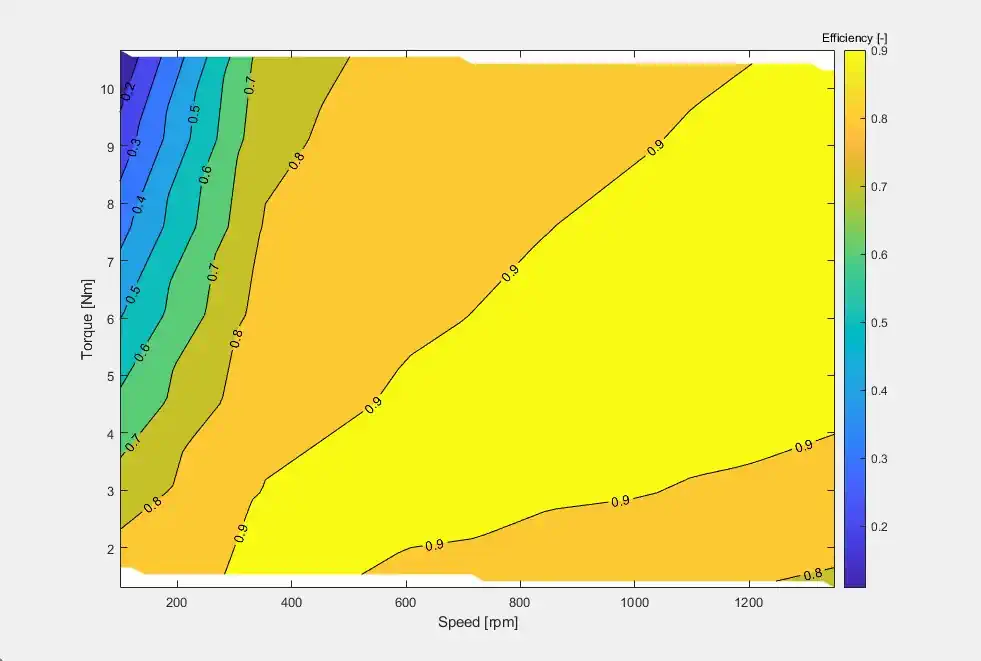
The efficiency map is typically presented as a graph with speed on the x-axis and torque on the y-axis. The graph is divided into different regions that represent the motor's performance at various operating points. Each point on the graph represents a specific combination of speed and torque, and the color or shading of the point indicates the efficiency of the motor at that operating point.
By analyzing the efficiency map, you can identify the regions where the motor operates most efficiently. These regions are typically located near the motor's peak efficiency point, which is the point where the motor delivers the highest mechanical output power with the least amount of electrical input power. Operating the motor within this region ensures that you are getting the most out of your motor while minimizing energy consumption.
In addition to identifying the efficient operating points, the efficiency map also helps you identify areas where the motor may be underperforming. For example, if you notice a significant drop in efficiency at a particular speed or load, it could indicate a problem with the motor or its control system. By identifying these underperforming areas, you can take steps to optimize the motor's performance and improve its efficiency.
Optimizing the performance of an electric motor involves adjusting the operating conditions to maximize efficiency. This can be done by selecting the appropriate gear ratio, adjusting the load, or fine-tuning the motor's control parameters. By referring to the efficiency map, you can easily identify the operating points that offer the highest efficiency and make the necessary adjustments to achieve optimal performance.
Understanding the efficiency map of an electric motor is crucial for ensuring that it runs at peak efficiency. By analyzing the map, you can identify the motor's optimal operating conditions, detect any underperforming areas, and make the necessary adjustments to optimize its performance. Ultimately, this can lead to significant energy savings and improved overall efficiency in your motor-driven systems.
The Role of Customization on Electric Motor Efficiency
While choosing the right size is crucial, the true pinnacle of efficiency lies in customization. Off-the-shelf motors may provide a baseline solution, but they often fall short in meeting the specific demands of unique applications. Custom electric motors, tailored to the exact requirements of the system, can deliver unmatched efficiency gains. You can work out the power, torque and speed relationship for your own operating point with our power-torque-speed converter.
Summary
In summary, we have broken down the concept of electric motor efficiency and its key factors. We've seen how tweaking things like torque, speed, and power can make a big difference. Plus, we've learned that tailoring electric motors to fit specific needs can bring about major improvements. With this newfound knowledge, you're now better equipped to make electric motors work smarter for different purposes. So, let's keep it simple and efficient, driving a greener and more powerful future in electric motor tech.
See how to generate and read an efficiency map for your own design in the Configurator Guide's Efficiency maps guide →
- Defining the Efficiency of Electric Motors
- Factors Influencing Electric Motor Efficiency
- Energy Efficiency Rating of an Electric Motor
- Exploring the Interplay of Torque, Speed, Power, and Efficiency in Electric Motors
- Efficiency Map of an Electric Motor
- The Role of Customization on Electric Motor Efficiency
- Summary