
Custom High-Efficiency Electric Motor Design
By Kaan Ozgen · Reviewed
Custom electric motor design starts from a simple observation: a motor with a 96% efficiency figure on its datasheet does not guarantee an efficient machine. Efficiency is a property of the whole application: the converter, the motor, any transmission between the motor and the load, and the load itself, all measured across the real duty cycle rather than at one rated point. Every time an application has to be bent around a motor, the difference shows up as losses.
The most effective way to raise the efficiency of an electric motor application is to reverse the process: start from the application, and design the motor for it. A motor built around your exact torque, speed, voltage and envelope needs no compromises to fit, and that is where application-level efficiency, weight and lifetime are won. Turncircles designs and builds custom axial flux motors with up to 96% efficiency and up to 20 years of lifetime.
Configure your motor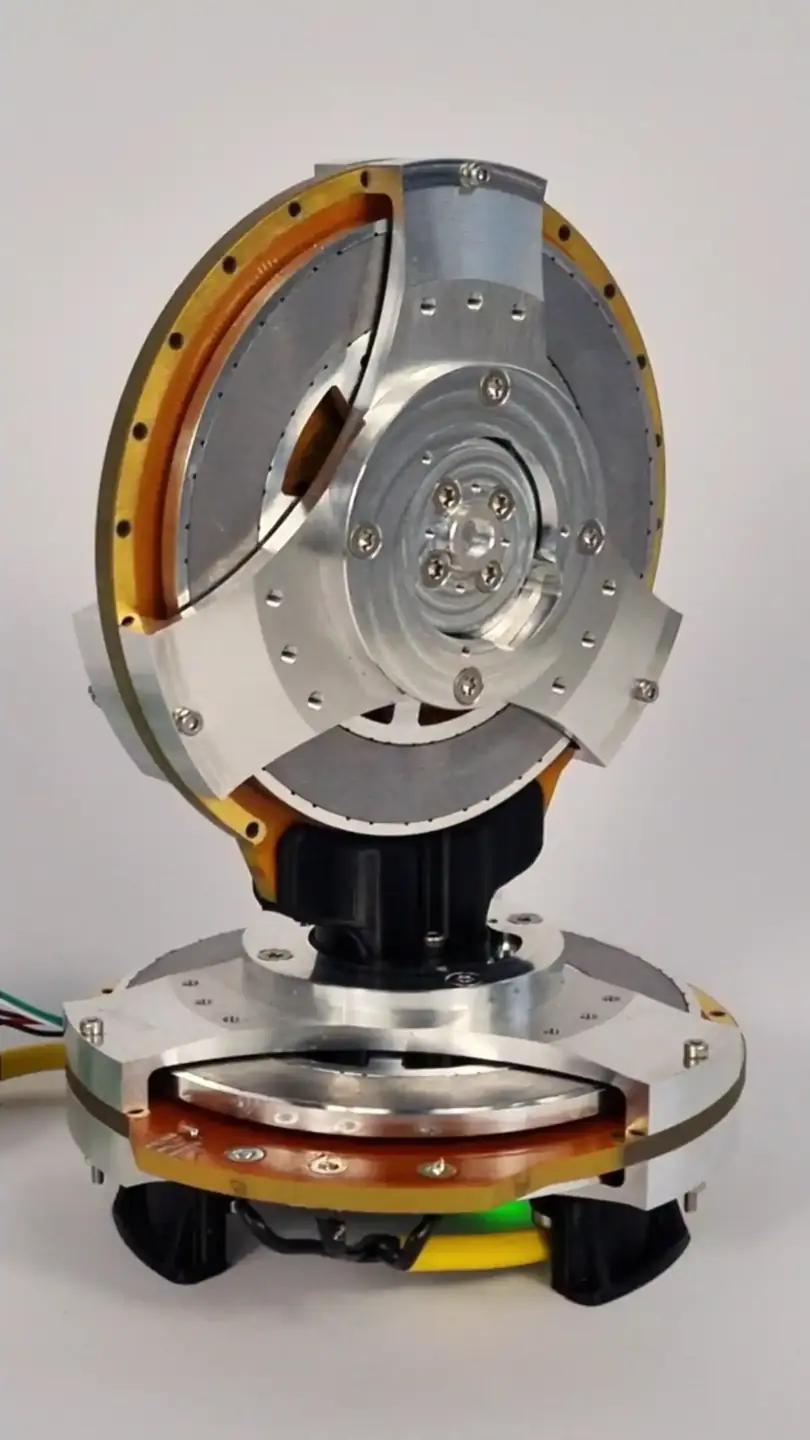
Efficiency is a system property
Losses multiply along the chain from converter to motor to gearbox to load. The weakest link sets the result.
Custom means matched
Winding, magnets, air gap, diameter and stack count are chosen for your torque, speed and voltage.
efficiency, available where your application actually operates.
of lifetime, in a coreless design with no iron losses to heat it.
Efficiency Is Decided at Application Level
Motor efficiency changes with speed and load, so it behaves like a map rather than one number: the region of highest efficiency, the efficiency island, sits in one particular part of the torque-speed plane. A datasheet quotes the top of that island. Your application lives wherever its duty cycle takes it, which is often somewhere else.
On top of that, the motor is rarely the only component between the energy source and the load. Efficiencies multiply, so a small loss in each stage becomes a large loss in total. The comparison below is illustrative: it uses typical figures to show how the structure of the drivetrain, not just the quality of the motor, sets the result.
Catalogue motor and gearbox
96% × 92% = 88%
A high-efficiency motor, adapted to the load with a gearbox. The motor is excellent, the drivetrain is not, and away from the rated point both stages lose more.
Custom direct-drive motor
up to 96% overall
Motor designed for the torque and speed of the load, so no transmission is needed. The efficiency of the motor is the efficiency of the drivetrain, which depends on delivering enough starting torque to move the load from a standstill.
Custom motor, matched gearbox
95% × 96% = 91%
Where a gearbox is unavoidable, the motor is designed to run at the gearbox's efficient operating point, instead of the other way round.
Illustrative figures for a well-loaded single gear stage; actual values depend on the gearbox type, load and speed.
Adapting the Application to the Motor Costs Efficiency
Choosing from a catalogue means the motor is fixed and the application has to adapt. Each adaptation has a price that the motor datasheet does not show:
- A gearbox to change speed and torque. Gear meshing, bearings and lubrication add friction losses, plus weight, noise, backlash and a wear item that limits the service life of the whole drive.
- Oversizing to reach the required torque. A motor that is larger than needed spends most of its life at partial load, far from its efficiency island, and carries extra mass all the time.
- Voltage and current mismatch. A winding that does not suit the supply voltage forces the converter to work at unfavourable currents, adding switching and conduction losses.
- Extra cooling and structure. Losses turn into heat, and heat needs fins, fans or a heavier housing to remove it.
A custom motor removes these adaptations at the source. The torque, speed and voltage of the application become the design inputs, so the efficiency island lands on the operating points that matter. See our efficiency definitions guide for the full breakdown of what drives it.
When a Gearbox Is Unavoidable, Design the Motor Around It
Some applications genuinely need a gearbox: very high output torque at very low speed, an existing mechanical interface, or a fixed load that cannot be changed. That is a legitimate design choice. What matters is which component adapts to which.
A gearbox has an input speed and torque range in which its losses are lowest, and it loses more outside of it. If the gearbox is chosen to suit an existing motor, one of the two is pushed away from its efficient region. If instead the motor is designed for the gearbox, the winding, voltage and speed are set so that the motor's own efficiency island coincides with the gearbox's best operating point. Both components then work where they are most efficient, and the drivetrain as a whole benefits.
What Designing the Motor for Your Application Means
Custom means the design parameters that decide efficiency are set from your requirements, rather than adapted from a standard motor built to order. In the Turncircles axial flux platform these are:
Winding and voltage
The number of turns and the wire geometry set the torque constant and the speed at a given supply voltage, up to 370 VDC. Matching them to your converter and battery keeps currents, and with them copper and switching losses, low.
Magnets and air gap
Magnet grade, magnet thickness and air gap decide how much flux crosses to the winding. They are tuned to deliver your torque with the least current, rather than fixed at a catalogue compromise.
Diameter and stacks
Torque grows quickly with diameter, and stacking adds power without enlarging the footprint. Speeds up to 6000 RPM and torque up to 24 Nm per stack continuous are available, so many applications can drive the load directly and skip the gearbox.
Weight and environment
The coreless stator has no iron, which removes core losses and can reduce weight by up to 50%. Protection up to IP67 and an operating range from -40 to +60 °C cover demanding installations. See how printed stators and naked or wet designs cut motor weight further.
For more on the topology behind these numbers, see axial flux vs radial flux motors.
Efficiency That Lasts for Years
Losses become heat, and heat is what ages a motor: insulation, adhesives and bearings all degrade faster when hot. A motor that wastes less energy in your operating range also runs cooler in it. Together with a design that avoids mechanical wear items in the drivetrain, this is how Turncircles motors reach up to 20 years of lifetime.
The efficiency gain carries through the life of the machine as lower energy consumption, less cooling, and fewer replacements, not just a one-off number on a test bench.
From Requirements to a Simulated Motor
You do not need to compare datasheets to find out what is possible. In the Turncircles configurator you define your own specifications, and the motor is designed for them:
- Enter the torque, speed, voltage and the envelope your application provides.
- Review the resulting motor design, weight and simulated performance across your operating range.
- Adjust the design until the efficiency island covers the points where your application runs.
- Request the motor, built to your specification.
Configuring a motor is free. Start from your application and let the motor follow. Not sure what numbers to start with? See sizing your motor before you configure. For a walkthrough of every step above, see the Configurator Guide.
Frequently Asked Questions
Is the most efficient catalogue motor the way to the most efficient application?
Not by itself. A datasheet efficiency is a single number at a single operating point, and it belongs to the motor alone. Your application sees the whole chain: converter, motor, any transmission, and the load, and it runs across a duty cycle rather than at one point. A motor with a 96% peak that has to be adapted to your application through a gearbox, oversizing or a mismatched voltage can deliver a lower application-level efficiency than a motor designed for your exact torque, speed and voltage.
What if my application needs a gearbox?
Then design the motor around the gearbox, not the other way round. Every gearbox has an input speed and torque range where its losses are lowest. A custom motor can be wound and sized so that its own highest-efficiency region coincides with that range, so the motor and the gearbox both work where they are best. Choosing the gearbox to suit an existing motor usually forces one of the two away from its efficient region.
Can a custom motor really beat a premium off-the-shelf motor?
Yes, when the comparison is made at application level. A catalogue motor is a compromise built to serve many customers. A custom motor is optimised for one load: the winding, magnets, air gap, diameter and stack count are chosen for your operating points. Turncircles motors reach up to 96% efficiency, and because the design matches the load, that efficiency is available where the application actually operates.
What efficiency and lifetime can I expect?
Turncircles axial flux motors reach up to 96% efficiency and up to 20 years of lifetime. Both are upper values that depend on the duty cycle, operating temperature and environment, which is why we size each motor against your actual requirements. Enclosures up to IP67 are available.
How do I get started?
Open the Turncircles configurator, enter your torque, speed, voltage and envelope, and review the simulated performance of the resulting motor. Configuring a motor is free, and you define your own specifications instead of comparing datasheets.
Design the motor around your application
Set your torque, speed and voltage in the Turncircles configurator and get a simulation-backed custom motor specification, free of charge.
Configure your motor