
Canned Motor vs Sealed Motor: A Ruggedized Wet Motor Guide
By Marius Blumenberg · Reviewed
A canned motor vs sealed motor decision comes down to where the fluid boundary sits. A ruggedized sealed motor keeps a conventional dry rotor and stator behind housing, seals, and potting that exclude the fluid entirely. A canned motor (a.k.a. wet motor), does the opposite: it lets the process fluid surround the rotor, and isolates only the stator winding behind a thin, non-magnetic can. Both are legitimate ways to build a wet motor; which one is right depends on the ingress protection class you need and the failure mode you can tolerate over the service life of the machine.
This guide helps you pick the right construction for your application; it doesn't make a case for either one. Turncircles builds both on the same PCB and DCB stator technology, so neither construction has a built-in advantage here.
Ruggedized Electric Motors: Sealed Construction vs. Canned Wet Rotors
A ruggedized sealed motor is, electrically, an ordinary dry motor. Housing design, static and dynamic seals, and potting compound keep its interior (windings, magnets, bearings) completely dry. The fluid never reaches an active component; keeping it out is the design's only job.
A canned motor takes the opposite approach: it accepts that the rotor runs in the process fluid, and isolates only the stator winding behind a thin, non-magnetic can, typically a stainless alloy, a composite, or a polymer sleeve. The can becomes the sole barrier between the wet side and the dry side of the machine; there is no shaft seal to fail, because the shaft never crosses a dry-to-wet boundary in the first place.
The wet motor vs dry motor framing is a useful shorthand, but it can mislead: a canned motor is also a wet motor by construction. The real distinction is where the fluid boundary sits, and what has to fail to breach it.
Motor Ingress Protection Classes Explained
An IP code has two digits. Per IEC 60529, the first digit rates protection against solid objects and dust, from 0 (none) to 6 (dust-tight, no ingress at all). The second digit rates protection against water, from 0 (none) up through 7 and 8 for immersion.
IPX7 is a fixed test: immersion to 1 m depth for 30 minutes. IPX8 isn't fixed the same way: the standard requires the exact depth and duration to be agreed between manufacturer and user, and to exceed the IPX7 level, but it does not define a universal value. That gap is where a common specification error happens. An IP68 electric motor rated for 1.5 m for 30 minutes and one rated for 5 m for 72 hours are both legitimately "IP68," and they are not interchangeable for a submerged-pump application. Quoting IP68 without stating the verified depth and duration is not a complete specification.
IP69K sits outside IEC 60529 entirely. It originates from the German DIN 40050-9 standard and now lives in ISO 20653, developed for road-vehicle equipment, and it tests something that IEC 60529 does not: close-range, high-temperature, high-pressure washdown, not immersion. An IP69K washdown motor rating says nothing about immersion depth, just as an IP68 rating says nothing about washdown pressure: they test different things for different purposes.
| Code | What it verifies |
|---|---|
| IPX4 | Splashing water from any direction |
| IPX6 | Powerful water jets from any direction |
| IPX7 | Immersion to 1 m depth for 30 minutes (fixed by the standard) |
| IPX8 | Continuous immersion, depth and duration agreed between manufacturer and user, must exceed IPX7; confirm what was tested |
| IP6K9K / IP69K | High-temperature, high-pressure close-range washdown (a separate test under ISO 20653, not IEC 60529) |
IP68 and IP69K in Practice: Where Sealed and Canned Motors Land
A ruggedized sealed motor reaches its IP class by construction: housing fit, gasket and dynamic seal design, and potting are specified and tested directly against IPX7, IPX8, or the IP69K washdown test, up to and including a submersible electric motor rated for continuous immersion at a stated depth. The IP class is a direct, testable property of the finished dry-side assembly.
A canned motor sidesteps the question for the rotor entirely. The rotor is designed to be wet, so "ingress" isn't the failure mode on that side at all. Instead, the canned construction moves the entire sealing burden onto two boundaries: the can itself, which must resist pressure, erosion and the specific process fluid without a pinhole developing, and the static seal where the can meets the stator housing. A canned motor's effective "IP rating" is a statement about can and joint integrity.
The Efficiency Trade: Can Losses (Eddy Current) and Thermal Path
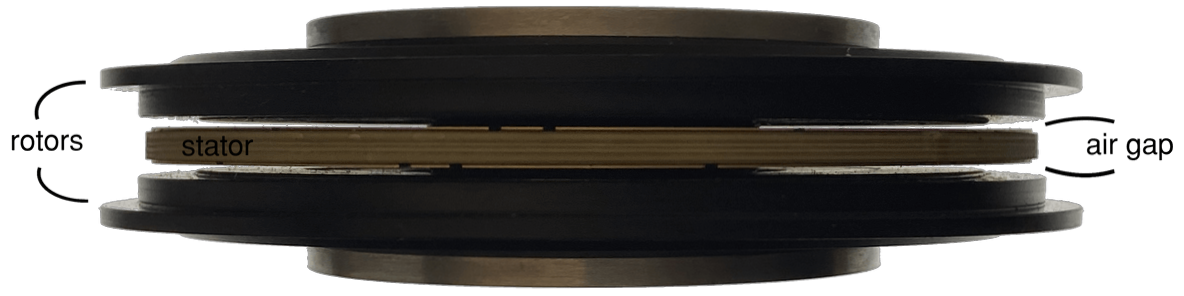
The can sits directly in the magnetic air gap, between the rotor magnets and the stator winding. A metallic can is electrically conductive, so the same time-varying field that drives the motor also induces eddy currents in the can, a continuous canned motor efficiency loss present at every operating point for the entire service life. Published analyses of metallic can designs put this loss on the order of roughly 0.5-2.5% of rated output, depending heavily on can material, thickness, and how well the design has been optimised (Liang, Hu, Liu & Li, "Calculation and Analysis of Can Losses of Canned Induction Motor," IEEE Transactions on Industrial Electronics, vol. 61, 2014). Non-metallic and composite cans reduce or eliminate this loss, but they generally carry a lower pressure rating than a metal can, so the efficiency gain is traded against the pressure and mechanical duty the can can withstand.
A ruggedized sealed motor avoids the can loss entirely (there's nothing conductive in the air gap), but it pays a different, ongoing cost: heat generated in the windings has to cross the sealed boundary to reach the fluid or ambient environment, through housing and potting rather than direct contact. That's the same thermal design question in a more constrained form, and it typically means a more conservative continuous power density for a given frame size. Neither approach is free; the efficiency and thermal costs sit on different sides of the fluid boundary.
Motor Lifespan in Wet Environments: Failure Modes Side by Side
The two constructions don't just fail at different times. They fail differently, which matters as much as raw service life for planning maintenance and tolerating downtime.
| Factor | Ruggedized sealed motor | Canned (wet rotor) motor |
|---|---|---|
| Dynamic seal wear | Present: shaft seal wears with every rotation and duty cycle | None: no dynamic seal crosses the fluid boundary |
| Bearing lubrication | Conventional grease or oil, isolated from the process fluid | Often lubricated by the process fluid itself, a non-ideal lubricant in most cases |
| Governing wear mechanism | Seal wear; thermal cycling can breathe moisture past static seals over time | Can erosion, fluid compatibility of the can material, bearing wear in the process fluid |
| Typical failure pattern | Gradual wear, but the failure itself is typically sudden once the seal lets go | Gradual degradation, but strongly fluid-dependent: abrasive or corrosive fluids shorten life materially |
Neither pattern is categorically better; they suit different maintenance philosophies. A sealed motor's sudden failure mode rewards condition monitoring and scheduled seal replacement. A canned motor's fluid-dependent, gradual degradation rewards knowing the process fluid's compatibility with the can material well before specifying the motor, since that single choice governs most of the achievable service life.
Choosing Between Them: A Ruggedized Motor for Harsh Environments
The decision between a ruggedized and a canned motor is usually clear from the application alone, but four questions narrow it further than the application label alone: whether the fluid is the process fluid itself or just the ambient environment the motor happens to sit in; whether it's corrosive or abrasive to likely can and seal materials; whether the duty cycle is continuous or intermittent with dry standby periods; and whether the unit is serviceable in place or a failure means a full pull and replace.
| Application | Typically favours |
|---|---|
| Clean washdown, food processing | Ruggedized sealed motor with an IP69K washdown rating: fluid is environmental, not continuous immersion |
| Submerged pumps, wet rotor pump motor designs | Canned construction: the fluid is the process fluid, immersion is continuous by design |
| Marine and subsea | Either, decided by immersion depth/duration (sealed, stated and verified) vs. can pressure rating (canned) |
| Chemical handling (a motor for chemical pump application) | Whichever construction has a can or seal material verified compatible with the specific chemical; compatibility governs life more than IP class here |
How Turncircles Builds Both
Turncircles' PCB and DCB coreless stator technology suits both constructions without modification to the underlying design philosophy. As a thin, flat, potted or ceramic-bonded assembly, it is an encapsulated stator motor by nature: well suited to sitting fully sealed behind a dry-side housing, and equally well suited to sitting directly behind a can, since it was never built around iron laminations that would need special protection from the fluid side in the first place. That means the sealed-vs-canned choice stays an application decision, driven by IP requirement and expected lifespan, rather than something the stator technology forces one way or the other.
Frequently Asked Questions
What is a canned motor?
A canned (or wet rotor) motor lets the process fluid surround the rotor. A thin, non-magnetic can isolates the stator winding from that fluid, so the sealing job moves from a dynamic shaft seal to a static can and a stator boundary that never moves.
Is IP68 enough for continuous immersion?
Only if the manufacturer states the depth and duration it was verified at. IEC 60529 does not fix a universal depth or time for IPX8: the test conditions are agreed between manufacturer and user and must exceed the IPX7 level (1 m for 30 minutes). "IP68" alone, without a stated depth and duration, does not tell you whether a motor is suitable for your actual immersion depth.
Do canned motors lose efficiency?
A metallic can sits directly in the magnetic gap and carries induced eddy currents, which is a continuous efficiency cost for the life of the motor, not a one-off penalty, typically on the order of 0.5-2.5% of rated output depending on can material and thickness (Liang, Hu, Liu & Li, IEEE Transactions on Industrial Electronics, vol. 61, 2014). Non-metallic or composite cans reduce this loss but generally have a lower pressure rating than a metal can.
Which lasts longer, a sealed or a canned motor?
Neither is universally longer-lived; they fail differently. A sealed motor's dynamic seal wears gradually but its failure, once the seal lets go, tends to be sudden. A canned motor has no dynamic seal to wear, so its life is usually governed by can erosion, fluid compatibility, and bearing wear in a non-ideal lubricant, which tends to degrade more gradually but depends heavily on the specific fluid.
Specify a ruggedized motor for your application
Whether sealed or canned suits your application, use the Turncircles configurator to set your torque, speed, and power requirements and get a simulation-backed motor specification in minutes.
Configure your motor