
Electric Motor Selector: How to Pick a Motor (or Skip the Picking)
By the Turncircles engineering team · Published
Choosing an electric motor feels like shopping for shoes in a country with a different sizing system. The good news is that five numbers from your application decide almost everything, and you can work them out in an afternoon.
This guide shows which five, how to get them from your load, why catalogue selectors tend to hand you something too big, and when it is better to stop picking and design the motor instead.
Use the configurator as your selector Open the power-torque-speed converter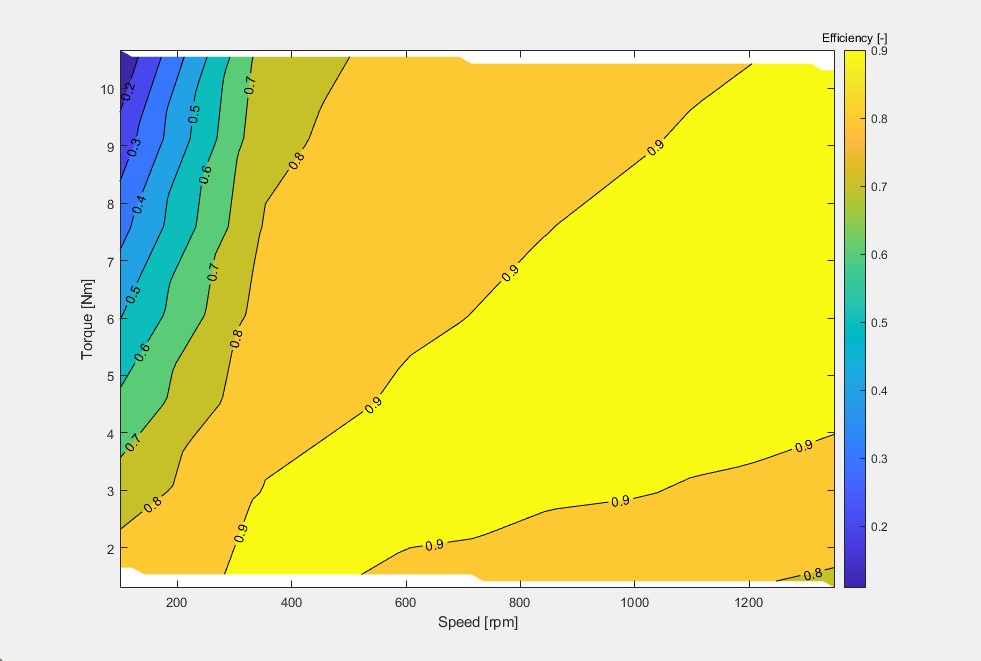
Five Numbers That Select a Motor
Every motor choice, however fancy the website, comes down to five numbers from your application:
| Number | Question to ask | Common mistake |
|---|---|---|
| Torque | How much at the load, continuous and peak? | Quoting only peak, then being surprised by heat |
| Speed | How fast does the load turn at the operating point? | Forgetting that a gearbox changes it |
| Voltage | What supply do you have or want? | Choosing the motor before the battery |
| Duty cycle | What share of the time at which load? | Sizing for one point instead of the profile |
| Envelope | Diameter, length, weight, mounting, environment? | Leaving it until the motor arrives |
From Load to Motor Numbers
Start from the load. If you know the force and the speed it moves at, you know the power. Convert power and speed to torque with T = P / ω. The power, torque and speed converter does it, the torque converter switches units, and the horsepower to watts converter rescues you from catalogues written in horsepower.
Then add margins: for friction you forgot, for acceleration (torque for inertia adds to torque for the load) and for temperature, because the continuous rating of a motor depends on how well its heat can leave. Our guide on sizing your motor before you configure goes through this in detail, and the robot joint actuator selection guide does it for a specific case.
A Worked Example: A Belt Conveyor Drive
A belt needs a pull of 150 N at 1.2 m/s over a drum of 0.10 m radius. The drum torque is 150 × 0.10 = 15 Nm. The drum speed is 1.2 / 0.10 = 12 rad/s, about 115 RPM. The power is 15 × 12 = 180 W. Add 30% margin for start-up and friction and design for about 20 Nm continuous.
A catalogue selector would now suggest a small fast motor and a gearbox with a ratio of 20 or more, because that is where cheap motors live. A direct-drive design delivers 20 Nm at 115 RPM with no gearbox: low speed, high torque, flat shape, which is the territory of a disc motor. Which is better depends on your cost target and noise, but you can only compare them once you have written the numbers down.
Catalogue Selectors and Their Habit
A catalogue motor selector filters a list. You enter torque and speed, and it returns the models that are at least that good, in descending order of how much bigger than needed they are. That is a legitimate method, and for a standard application it is quick. Its habit is to hand you an oversized motor, which then runs at partial load, away from its efficient region, and carries extra mass all day. The custom electric motor design page explains why that costs efficiency.
Or Skip the Selecting
The alternative is to treat the five numbers as inputs to a design, instead of filter criteria for a list. That is what the configurator does: you enter torque, speed, voltage and diameter, and it returns a motor made for them, with simulated performance and a price. If your numbers are not clear yet, the guides above get you there first.
Two free tools help if you want to explore before you register: the magnet selector for magnet choices and the winding calculator for pole and slot combinations.
A Selection Checklist
- Write down continuous and peak torque at the load.
- Write down the speed at the operating point and the maximum speed.
- Decide the supply voltage and the current limit.
- Describe the duty cycle: what happens in a typical hour.
- Measure the space and note the environment: temperature, water, dust.
- Decide if a gearbox is a requirement or a habit.
- Enter the numbers and compare the result with your margins.
Frequently Asked Questions
How do I select an electric motor?
Determine continuous and peak torque, speed, supply voltage, duty cycle and available space from your application. Then choose or design a motor whose efficient operating region covers the points where your application runs most.
How do I calculate the torque I need?
Torque equals power divided by angular speed, T = P / omega, with omega in radians per second. Add torque for acceleration of the inertia and a margin for friction. The power, torque and speed converter does the arithmetic.
Should I choose the motor or the gearbox first?
Neither, ideally. Choose them together, or avoid the gearbox. If a gearbox is unavoidable, design the motor around the efficient input range of the gearbox instead of the other way round.
What is the difference between peak and continuous torque?
Peak torque is what the motor can deliver briefly, limited by current and magnetic saturation. Continuous torque is what it can deliver indefinitely, limited by heat. Select on continuous torque for steady loads and check peak for acceleration.
Is there a free motor selector?
The Turncircles configurator is free to use and designs the motor from your requirements. The converters, magnet selector and winding calculator on this site are free and need no account.
Enter your numbers, get a motor
Torque, speed, voltage and diameter in. A simulated motor out.
Configure your motor Talk to an engineer