
How a Custom Electric Motor Is Designed
By Kaan Ozgen · Published
A custom motor design starts with what the motor must do, not with a catalogue. This guide walks through the steps from requirements to a built motor, shows the inputs each step needs, and explains the trade-offs that shape the final design.
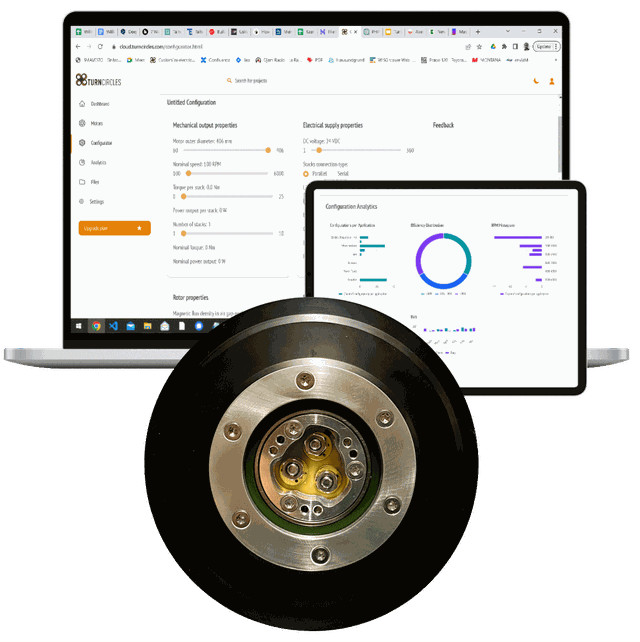
With the Turncircles configurator, the first two steps take minutes: you get an analytical design and an indicative price straight away, and a simulated motor you can evaluate before you commit to a prototype.
1. Start With the Requirements
Requirements decide everything that follows. Fill in this sheet before you contact any supplier; the example column describes a robot joint.
| Item | Example | Why it matters |
|---|---|---|
| Continuous torque (Nm) and speed (rpm) | 20 Nm at 200 rpm | Sets the thermal load and the power |
| Peak torque and duration | 35 Nm for 2 s | Sets the magnetic and mechanical limits |
| Supply voltage (V) | 48 V DC | Sets the winding and the controller |
| Envelope: diameter and length (mm) | 120 mm × 40 mm, including mounting | Sets the topology and the gap area |
| Mass limit | 1.2 kg, complete motor | Sets the materials and the construction |
| Environment: temperature and IP rating | −20 to +50 °C, IP54 | Sets the housing and the seals |
| Duty cycle | 40% on, 60% off, 10-minute cycle | Sets the thermal design |
| Quantity | 1 prototype, then 50 per year | Sets the process and the cost |
If you do not know a value, say so rather than guessing. An honest "unknown" is easier to design around than a number that turns out to be wrong after the prototype. The motor sizing guide shows how to derive torque and speed from the load.
2. Work Out the Power and Speed First
Mechanical power follows from torque and speed:
P (W) = T (Nm) × ω (rad/s), ω = rpm × 2π ÷ 60
For the example: ω = 200 × 2π ÷ 60 = 20.9 rad/s, so P = 20 × 20.9 ≈ 419 W at the continuous point, and about 733 W at the 35 Nm peak if it occurs at the same speed. Check the result at the extremes of the speed range, because torque and power rarely hold across the whole range. The power from torque calculator does the conversion.
3. Choose the Topology
The first design decision is the topology: axial or radial flux, coreless or iron-cored, sealed or wet. The requirements usually point to one or two options.
| If the requirement is… | It points toward |
|---|---|
| Wide diameter, short length, high torque | Axial flux |
| Long envelope, high speed, high volume | Radial flux |
| Low ripple, no core loss, low mass | Coreless stator |
| High torque per magnet volume, cost-driven | Iron-cored stator |
| Immersion, washdown or a harsh fluid | Sealed or canned (wet) construction |
If two topologies remain, run both through the design study and compare the results on the same basis.
4. Run the Design Study
The design study has three parts. Each one can change the result, so each needs its own check.
Electromagnetic design. Choose the number of poles and slots (or coils), the magnet grade and thickness, the air gap and the winding. These set torque, back-EMF, and the voltage and current the controller must supply. The winding calculator and the magnet selector show two of these choices in isolation.
Thermal design. Estimate the losses in the winding, the magnets and any iron, and check the temperatures over the duty cycle. A design that meets the torque on paper can still overheat in continuous use.
Mechanical design. Check the axial magnetic force, the bearing loads, magnet retention at top speed and the mounting. This part often reveals the envelope limits early.
In the Turncircles configurator you enter the requirements and get an analytical design with an indicative price straight away; you then run a finite-element simulation of the same design, which returns torque, back-EMF and an efficiency map. The study confirms the design before any winding is made.
5. Make the Trade-offs Explicit
Almost every design involves trade-offs. The common ones:
| Trade-off | One side | Other side |
|---|---|---|
| Diameter against length | Wider motor, more torque in a short length | More mass and a larger mounting footprint |
| Magnet volume against copper | More magnet, higher torque per amp | Higher cost and more magnet mass |
| Torque against speed (winding) | More turns: more torque per amp, lower top speed at a given voltage | Fewer turns: higher speed, more current for the same torque |
| Iron against coreless | Iron: more torque per magnet volume | Iron adds mass, cogging and core loss; coreless needs a larger magnetic gap |
| Mass against cooling | Lighter housing | Less surface and thermal mass for heat removal |
A good design study shows the options and what each costs in torque, mass, thermal margin and price, so you decide with the numbers in front of you. Why matching the motor to the application matters more than any single datasheet figure is covered in custom high-efficiency electric motor design.
6. Build a Prototype and Test It
A prototype confirms the design. The measured results are compared with the simulation: torque, back-EMF, temperature rise and efficiency at the points you run. Differences between simulation and test are normal; large differences are a reason to check the model, not to ignore it.
7. Move to a Series
After the prototype, the series is quoted. The quote depends on quantity, materials, the test plan and any changes made after testing. Series work needs a frozen design, incoming-material checks and an agreed routine test for every unit.
8. Lead Times
| Stage | Typical lead time | Notes |
|---|---|---|
| Analytical design and indicative price | Minutes, in the configurator | From your requirement values |
| Simulation | Run from the configurator | Depends on the design and the queue |
| Assembly, standard materials | As little as 20 working days | Once the design is fixed |
| Assembly, rare-earth magnets | Up to about 50 days | Customs clearance on the magnets sets the schedule |
| Series | Quoted per order | Depends on quantity and materials |
Ask for a dated schedule with every quote; a lead time without a start date is not a schedule.
9. What It Costs
Each design is priced on its own. The configurator gives an indicative price for the analytical design as soon as you enter your requirements, and the quote for a prototype or series follows from the same design, the materials, the quantity and the test plan. The analytical results and price guide explains how the indicative price is built up.
10. What to Send
Start with the requirement sheet above. If you have a datasheet of a motor you want to replace, a drawing of the envelope or a duty-cycle profile, send those too. Missing information slows the study, so send what you have and say what you do not know.
11. Frequently Asked Questions
How is a custom electric motor designed?
It starts from a requirement sheet (torque, speed, voltage, envelope, mass, environment, duty cycle), then the topology is chosen, an electromagnetic, thermal and mechanical design study is run, and a prototype is built and tested against the simulation before a series is quoted.
How much does a custom electric motor cost?
Each design is priced separately. The Turncircles configurator gives an indicative price for the analytical design as soon as you enter your requirements; prototype and series quotes depend on materials, quantity and the test plan.
How long does a custom motor take?
Assembly takes as little as 20 working days for standard materials once the design is fixed. Designs with rare-earth magnets can take up to about 50 days because of customs clearance on the magnets.
Do I need to know motor design?
No. The requirement sheet is what is needed. If you can describe the application and the load, the design can start from there.
Will I see a simulation before I pay for a prototype?
Yes. The analytical design and the simulation come before the prototype.
Can you match an existing motor?
Often. Send the datasheet and describe the application behind it. We will say whether a match is realistic and what would change.
Configure your motor
Enter your requirement sheet in the configurator and get an analytical design and an indicative price in minutes. Prefer to talk first? Use the contact form.
Configure your motor