
What Is a Pancake Motor?
By Kaan Ozgen · Published
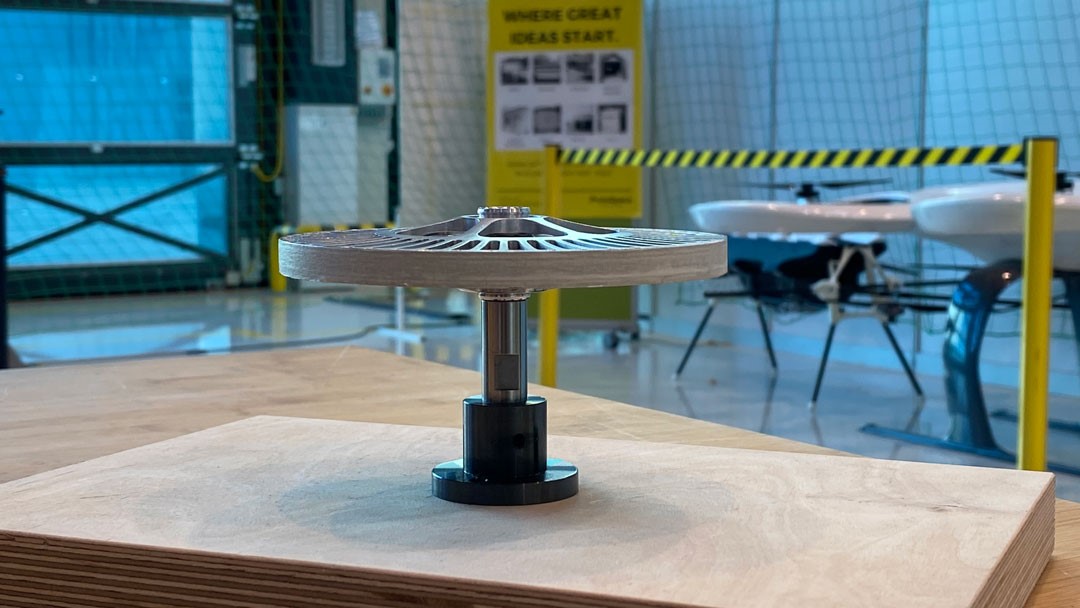
A pancake motor is a motor whose diameter is large compared with its length. "Pancake" describes the proportions of the machine; it does not say how the magnetic flux flows, so a flat motor can be radial or axial flux. Pancake motors fit where the space along the shaft is limited, such as wheel hubs, robot joints, drone arms and gimbals.
This page separates shape from flux path, shows with two worked examples what a flat motor gains and costs, and lists the questions that expose the differences between pancake motor datasheets.
Table of contents
- 1. Shape and Flux Path Are Different Things
- 2. Why the Shape Matters
- 3. Worked Example: Two Envelopes, Same Axial Length
- 4. Worked Example: Torque, Speed and Power
- 5. Where a Flat Motor Helps
- 6. Where a Flat Motor Is Harder
- 7. How to Choose Between a Pancake and a Conventional Motor
- 8. Questions to Ask Any Pancake Motor Supplier
- 9. Turncircles Pancake Motors
- 10. Glossary
- 11. Frequently asked questions
1. Shape and Flux Path Are Different Things
People use "pancake motor" and "axial flux motor" as if they meant the same thing. They overlap, but they describe different properties:
| Term | Describes | Example |
|---|---|---|
| Pancake | Proportions: diameter much larger than length | Flat hub or joint motor |
| Axial flux | Direction of the magnetic flux across the gap | Disc stator facing disc rotors |
| Radial flux | Direction of the magnetic flux across the gap | Short cylindrical stator inside a ring rotor (outrunner) |
The name comes from disc-armature DC motors, such as printed-circuit motors, whose flat armature turns in an axial gap, so the original pancake motors were axial flux. Today the word is used for any flat motor. Many flat gimbal and drone motors are short radial flux outrunners, while flat motors built for high torque in a short length are more often axial flux, because a flat gap puts the active area where the flat shape helps. Check the flux path on the datasheet before assuming the shape gives you the performance.
The axial flux motor guide explains the axial layout in detail.
2. Why the Shape Matters
Torque is force acting at a radius. A larger diameter gives a longer lever arm and more gap area, so a flat, wide motor can deliver its torque in a short axial length. That is the benefit people are after when they search for a pancake motor.
The shape has consequences too:
- The diameter has to be supported. A wide rotor needs a stiff structure and bearings that carry the magnetic pull between rotor and stator.
- The envelope has to be checked early. A large diameter may not fit the mounting on the system you are building.
- Heat leaves through a different surface. A sealed flat motor at continuous load can run hot; see electric motor temperature.
3. Worked Example: Two Envelopes, Same Axial Length
Suppose you have 40 mm of axial space for a motor in a hub:
- Option A: 80 mm diameter, 40 mm length
- Option B: 120 mm diameter, 40 mm length
In the simple torque model for an axial flux machine, torque scales with the cube of the outer radius at a fixed inner-to-outer ratio and a fixed shear stress. Option B has 1.5 times the diameter of option A, so in the model:
TB ÷ TA = 1.53 ≈ 3.4
That is a large difference, but it comes with more magnet and copper mass and a larger mounting footprint, and it assumes the larger motor can be cooled to the same shear stress. Check the mass basis and the envelope before you pick a diameter. The model shows the trend; it does not give the final torque.
4. Worked Example: Torque, Speed and Power
A robot joint needs 20 Nm continuous at 200 rpm. The mechanical power at the output is:
ω = 200 × 2π ÷ 60 = 20.9 rad/s
P = 20 Nm × 20.9 rad/s ≈ 419 W
If the joint runs at 60 rpm instead, the same torque needs only about 126 W. The power changes with speed, but the torque the motor must make stays the same. That is why a flat motor at low speed is sized mostly by torque, and why speed decides the power rating of the drive. The power from torque calculator does this conversion for any pair of values.
5. Where a Flat Motor Helps
- Torque in a short axial space. A wide, short motor fits a tight hub or joint and still gives torque.
- Direct drive. Some flat motors run without a gearbox, which removes gearbox losses and backlash. Check that the required speed suits direct drive; flat motors usually run best at moderate speed.
- Stacking. Axial designs can add stages to raise torque without changing the outer diameter.
- Packaging. The flat shape can sit flush with the structure, which simplifies integration; a naked motor can even use the host structure as its housing.
6. Where a Flat Motor Is Harder
- Axial force. Single-sided layouts pull the rotor toward the stator. Bearings and housing must carry this load.
- Thermal path. A sealed or closed housing can trap heat. Calculate the thermal path for continuous duty.
- Speed. High-speed operation needs magnet retention and balance on a wide rotor. If your speed is high, check the design with the supplier.
- Gearing decisions. If the speed you need does not suit the motor, a gearbox is added. Decide early, because the gearbox changes the envelope and the mass.
7. How to Choose Between a Pancake and a Conventional Motor
| Question | If yes | If no |
|---|---|---|
| Is the space along the shaft tight? | A pancake shape is worth a look | A longer motor may be simpler |
| Is the diameter available? | A flat shape can deliver the torque | Check whether a larger diameter is possible |
| Do you need direct drive? | A flat motor with high torque at low speed suits | A gearbox or high-speed motor may be needed |
| Is mass a hard limit? | Compare options on the same mass basis | A standard motor may be cheaper |
| Is the duty continuous at high torque? | Ask for the thermal analysis | Peak-only duty is less demanding |
8. Questions to Ask Any Pancake Motor Supplier
- What is the continuous torque, and what is the peak torque and for how long?
- Is the torque or power density figure based on active parts or on the complete motor?
- What is the axial length including mounting?
- Is the motor axial or radial flux, and is the stator iron-cored or coreless?
- How is the motor cooled, and what thermal duty is assumed?
- Do the datasheet figures come from a test or a simulation?
- What speed range does the rated torque apply to?
9. Turncircles Pancake Motors
Turncircles builds custom axial flux motors in pancake form, with coreless PCB or DCB stators. The design starts from your torque, speed, supply voltage and envelope. The configurator returns an analytical result and an indicative price, you run a simulation of the same design, and you can then request a built motor. The motors cover an operating range from −40 to +60 °C, with protection up to IP67 where the application needs it.
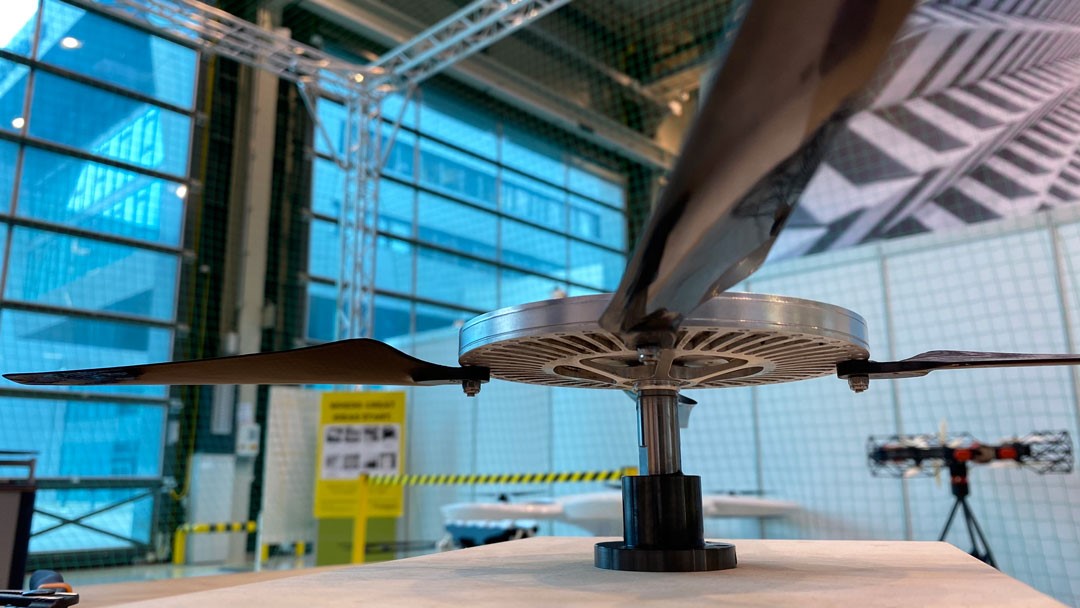
For weight-critical builds, the lightweight axial flux motor page explains naked and wet motors that save the housing mass.
10. Glossary
- Pancake motor: a flat motor whose diameter is much larger than its length.
- Envelope: the maximum diameter and length the motor may occupy, including mounting.
- Direct drive: the motor drives the load without a gearbox.
- Backlash: play in a gearbox, which a direct-drive motor avoids.
- Outrunner: a motor whose rotor turns outside the stator; most flat drone motors are radial outrunners.
11. Frequently Asked Questions
What is a pancake motor?
A motor whose diameter is much larger than its length. The term describes the proportions, not the flux path: a pancake motor can be axial flux or radial flux.
Is a pancake motor the same as an axial flux motor?
Not always. The original pancake motors were disc-armature axial flux machines, and flat motors built for high torque are often axial flux, but many flat drone and gimbal motors are radial flux outrunners.
Are pancake motors more efficient?
Shape alone does not set efficiency. The winding, magnets, cooling and operating point do. Ask for an efficiency map at the points you actually run.
Can a pancake motor run without a gearbox?
Some can, because a flat motor can make high torque at low speed. Check that your torque and speed requirement fit the motor's range before you design it in.
What is the difference between a pancake motor and a hub motor?
"Hub motor" describes where the motor sits, usually inside a wheel. "Pancake motor" describes its shape. A hub motor can be a pancake motor, but not every pancake motor is a hub motor.
Can you make a custom pancake motor?
Yes. Enter your torque, speed, voltage and envelope in the Turncircles configurator, or send them through the contact form, and we reply with a design recommendation.
Configure a pancake motor
Start from your torque, speed, voltage and envelope. The configurator returns an analytical design and an indicative price, ready to simulate.
Configure your motor