
Robotics Electric Motors: A Custom Axial Flux Motor for Joints and Actuators
A robot joint rarely fits a catalogue motor. We build a new, assembled axial flux permanent magnet BLDC motor to the holding torque, speed and envelope of your joint or actuator, from a single unit.
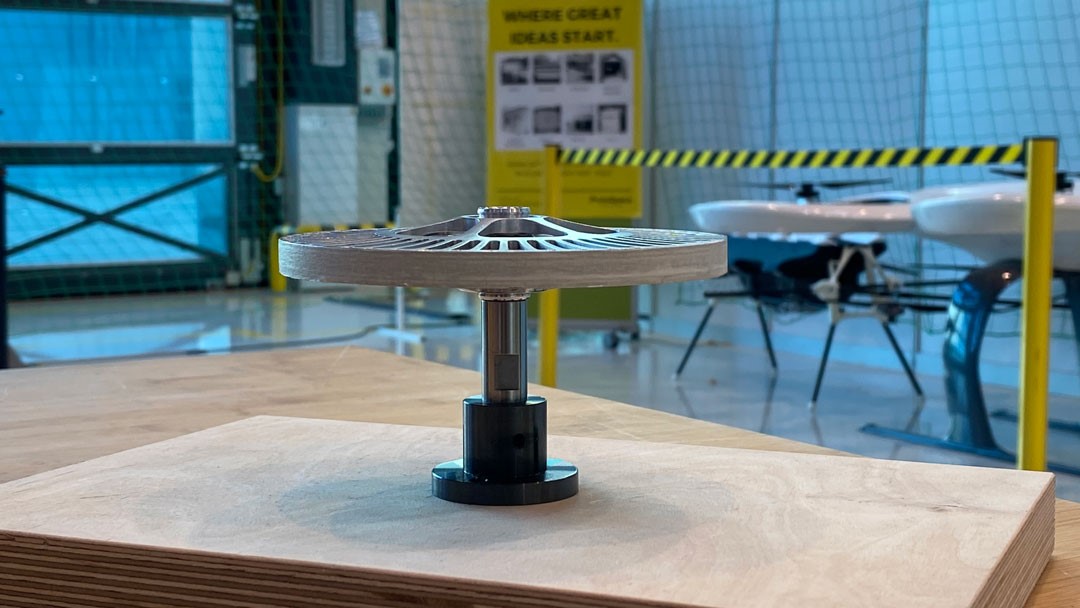
The flat disc shape suits joints where axial length is scarce, and rotor-stator pairs can be stacked when a joint needs more torque in the same diameter.
From €12,100 incl. 21% VAT (€10,000 excl. VAT, one motor including its electrical design) · Lead time from 1 month · Shipping calculated separately; defective parts replaced at no cost, no other returns · Pricing details
Configure your robotics motor Talk to an engineerWhat You Receive
- An assembled axial flux BLDC motor with permanent magnet rotors and printed (PCB or DCB) stators.
- A stackable design. Outer diameters from 60 mm to 406 mm; more rotor-stator pairs add torque without a larger diameter.
- Housed or naked. A housed motor with protection up to IP67, or rotor and stator only, mounted straight into the joint structure.
- Simulated data for the design you ordered, including its efficiency map.
Why It Suits Robot Joints
No cogging. The coreless stator has no iron for the magnets to detent against, so there is no cogging torque for the position loop to fight at low speed and standstill. See the coreless stator explained.
Direct drive is an option. A large-diameter motor delivers torque at joint speed, so the joint can run without a gearbox and without backlash. Where a gearbox is still the better trade, a smaller, faster motor can be configured instead.
Short axial length. A flat motor fits inside the joint instead of sticking out of it, which is why pancake motors are common in robot arms and actuators.
Sizing a Joint Motor
Size for the continuous holding torque at your real mounting and cooling condition, not for a peak value: a joint that holds an arm against gravity runs near zero speed with little airflow, and heat sets the limit there. The robot joint and actuator motor selection guide walks through accuracy, backlash, feedback and thermal limits, and the configurator shows the simulated torque and efficiency for your design.
Ordering and Lead Time
- Configure the motor in the configurator and run the simulations. Both are free.
- Order when the simulated performance convinces you. The minimum order is one motor; the cost per motor becomes economically viable from about 8 to 10 motors.
- After the design is final, the parts are made in parallel: PCB stators usually take 20 working days, structural parts about 14 days, and rotors up to 50 days because of neodymium magnet procurement.
The price breakdown and a live estimator for larger orders are on the pricing page.
Frequently Asked Questions
Is the motor free of cogging torque?
The coreless stator contains no iron, so there is no cogging torque from magnets detenting against a core. Remaining torque ripple depends on the design and is shown in the simulation.
Can the motor be built without a housing?
Yes. A naked motor is delivered as rotor and stator only and is mounted into the joint structure, which then provides the bearings and support.
Can I order a single motor for a prototype robot?
Yes. The minimum order is one motor. The cost per motor becomes economically viable from about 8 to 10 motors.
How long does delivery take?
Lead time starts from about one month after the design is final. PCB stators usually take 20 working days and rotors up to 50 days because of magnet procurement.
Build the motor your joint needs
Configure it for your holding torque and speed and read the simulated efficiency map before you order.
Configure your motor Talk to an engineer