2. Mechanical output properties
This card describes what the motor must deliver at the shaft. Everything else in the design is sized to meet these numbers, so start here.
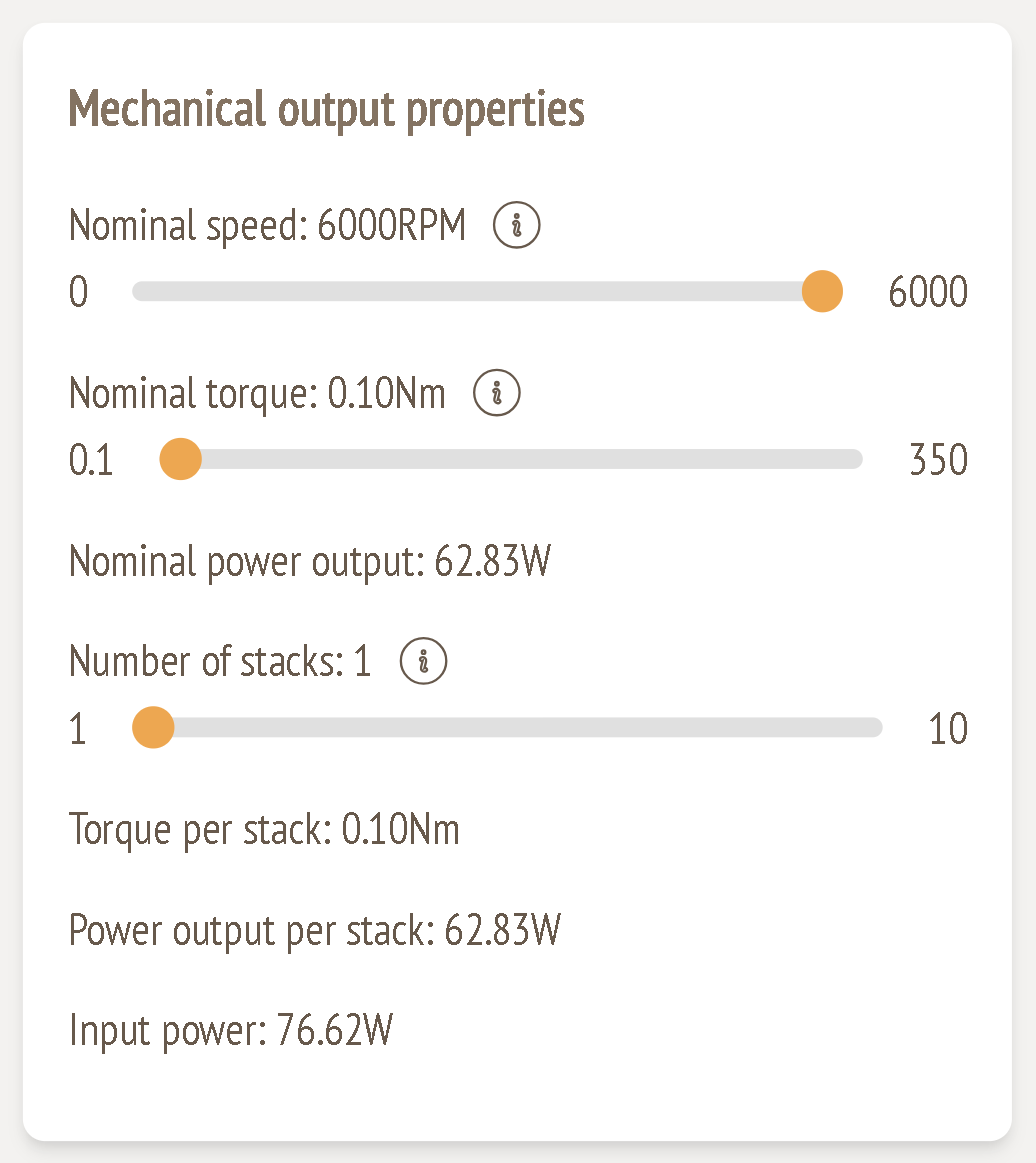
Inputs
Nominal speed (RPM)
Range: 0 – 6000 RPM
This is the shaft speed at the operating point you design for. It should match the speed your application needs in typical use, which is usually its maximum continuous speed. If you're replacing an existing motor, use the rated speed from its datasheet, where the motor runs most efficiently at rated power.
Nominal speed sets the electrical frequency (see guide 8) and, together with torque, the output power.
Nominal torque (Nm)
Range: 0.1 – 350 Nm
This is the continuous torque needed to keep the load moving at nominal speed. When you pick it, think about:
- Load: how much torque the driven load needs at steady speed.
- Duty cycle: whether the motor runs continuously, intermittently, or under varying load. The nominal torque must cover the highest sustained load.
Number of stacks
Range: 1 – 10
A stack is one complete rotor–stator–rotor unit. Stacks sit side by side on the same shaft and share the torque. Adding stacks increases torque and power without changing the electrical design of each stack. The trade-off is a longer motor with more parts and connections, and so more places where a mechanical or electrical fault can occur.
For small motors (stator outer diameter under 300 mm), the card warns you:
- 4–6 stacks: amber warning
- More than 6 stacks: red, and the configuration is invalid
The warning reads "Use axial space by increasing rotor outer diameter and aim for lowest number of stacks possible" and shows the current efficiency. A larger diameter usually adds torque more effectively than extra stacks.
Calculated values
| Value | Meaning | In the example |
|---|---|---|
| Nominal power output | Shaft power at the nominal point: P = T × ω, where ω = 2π × RPM / 60 | 0.10 Nm × 628.3 rad/s = 62.83 W |
| Torque per stack | Nominal torque divided by the number of stacks. Each stack is designed for this torque. | 0.10 Nm |
| Power output per stack | Nominal power divided by the number of stacks | 62.83 W |
| Input power | Estimated electrical input power at the nominal point, including losses. The phase current in the Electrical card is derived from it. | 76.62 W |