
A VTOL Cargo Drone Concept
By Kaan Ozgen · Reviewed
In May 2016, Airbus called for a VTOL Cargo Drone design challenge via Local Motors. They were looking to identify the next generation of multi-purpose drones, a safe, easy-to-operate, and affordable drone solution: an innovative VTOL aircraft for small-scale cargo transport with electric propulsion motors.

We have come up with a pretty sweet VTOL cargo drone concept with integrated hub electric motors. In this article, we present our VTOL cargo drone solution with electric propulsion motors: how this design came together, the pros and cons we recognized, and what makes this concept an ultimate VTOL cargo drone for the aerospace industry. If you're new to multirotor and VTOL aircraft, our article on what is a drone covers the fundamentals.
Information Provided by Airbus
Here we start with the problem description and the features required by Airbus, presented below in the original text. At the bottom of this page, you can find these requirements in a simplified list.
The Problem
As technology advances, so do opportunities. The global use of drones is ever-growing, however commercial and civil-use drones do not yet play the important role they should. The notion that autonomous aircraft are restricted, via cost and law, to government and military uses is vastly diminishing, and civil drones have become the next frontier.
Imagine sending a vital piece of hardware from your distribution center directly to your manufacturing facility across town in 15 minutes without a truck driver. Or flying in life-saving medicine and vaccines to remote areas of the world without needing any highway infrastructure.
Other civil drone systems have had marginal success, but not with the bandwidth Airbus intends to use. This project will create a new standard of parcel delivery, humanitarian missions, and health care capabilities for improved quality of life for everyone.
Features
The solution must allow for simple reconfiguration or adaptation, as it will be used, safely and effectively, for things such as agriculture monitoring, infrastructure inspection, cargo delivery, or humanitarian missions.
The aircraft shall be designed for vertical takeoff and landing (VTOL), and efficient forward flight: a hybrid design created through the merging of design elements from both multi-rotors and fixed-wing aircraft. As such, the aircraft shall include at least 4 rotors (lifting motors / rotors). All propulsion shall be directly driven, fixed-pitch propellers, and the total number of motors shall not exceed 10. The aircraft will operate in two flight modes: a hover mode for takeoff and landing, and a forward flight mode for efficient travel. At least one motor must be used for forward thrust in the fixed-wing flight mode.
While keeping in mind that the payload concept should be modular (i.e. suitable for cargo transport, mounting sensors, or other applications), the aircraft shall be designed to weigh less than 25 kg with a single, fixed, internal cargo bay that accepts a payload from 3 to 5 kg. The aircraft shall be able to accommodate a minimum payload dimension of 450 x 350 x 200 mm. All payloads shall be restrained within the payload bay to avoid shifting during flight, regardless of size or weight. The cargo in the payload bay shall be easily accessible and interchangeable, and impossible to jettison in flight. The cruise speed of the aircraft in forward flight should be at least 80 km/h, and maximum speed shall not exceed 194 km/h. The power system shall be purely electric, with energy storage in the form of an off-the-shelf rechargeable battery.
The aircraft design shall avoid the use of tilting wings or tilting motors/rotors for the sake of simplicity. This helps minimize manufacturing costs and reduces the number of potential points of failure. Along the same lines, variable pitch propellers shall be avoided.
It should be clear that the intent of this aircraft is for medical cargo delivery, humanitarian missions, and other civilian applications. There should be no design concessions made for military use: no weapons, armor, or countermeasures.
The most successful entrants will keep simplicity in mind, and their designs will be optimized for ease of use, including maintenance, as quick a turnaround as possible between flights, swappable batteries, and ease of cargo loading and unloading. Designs should also consider the ability of the aircraft to operate safely in all states of flight, including wind conditions up to 10 m/s, a temperature range of −30 to 50°C, and moderate rain.

Our VTOL Cargo Drone Concept with Electric Propulsion Motor
Below is how we approached the fuselage, wings, propulsion motor, cockpit, and payload bay to meet Airbus's requirements.
Fuselage
Having safety in mind, we focused on gliding concepts only, so that in case of all-systems failure the drone would still safely land even if the parachute fails to open.
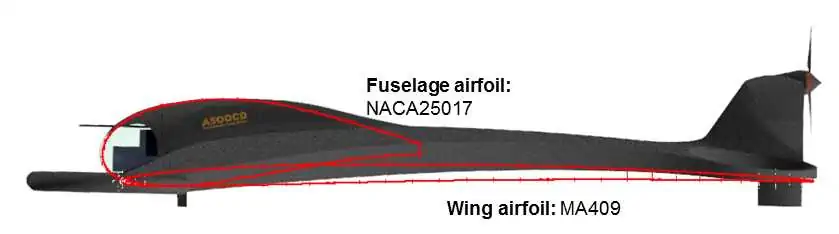
For the fuselage we chose the NACA 25017 airfoil, which covers the 350 x 200 x 450 mm payload and smoothly integrates with the wings.
Wings
For this concept, we were inspired by the "flying squirrel" (a.k.a. sugar glider), which also inspired the development of "wingsuits".
We chose the MA409 airfoil, designed for free flight applications and proven in numerous unlimited fly-offs for fast climb and good glide endurance. The MA409 has a low zero-lift drag coefficient, which aids overall performance.
Wings are designed to be foldable, making transport flexible and easy.
Electric Propulsion Motor
We call it an "Electric Propulsion Motor" because the propeller becomes the rotor of the electric motor, and is therefore part of the electric motor itself.
We preferred ducted propellers to secure safety on the ground and to avoid using servo-motors, keeping flight control simple.
Vertical takeoff and hover demand high starting torque from a standstill, and the outdoor, all-weather duty cycle of a cargo drone makes ingress protection against dust and moisture a core design requirement.
By the way, if you haven't checked out our ultra light custom axial flux DC electric motor yet, you may want to take a look now.

Cockpit / Nose Fuselage
We placed all vital flight systems (flight control computer, antennas, transponder, communication system, and camera system) in a waterproof cockpit. The cockpit also serves as the cargo door, and is power supplied by a spring cable connected to the battery, which we placed right in the middle of the drone, at the center of gravity.
Optionally, we can apply a vacuum to improve thermal convection and avoid humidity inside the cockpit.

Payload Bay
A single payload bay is located near the aircraft's center of gravity. Minimum payload bay dimensions are 450 x 350 x 200 mm. The payload bay is located and accessible from the lower side of the aircraft, and is interchangeable with a payload bay of the same size and interface, so the payload concept stays modular for applications beyond cargo, such as sensor payloads.

So We Did Deliver!


List of Requirements
- The design shall be capable of vertical takeoff and landing
- The aircraft shall include at least one fixed wing for forward flight
- Maximum takeoff mass (MTOM) shall be below 25 kg: vehicle weight when fully loaded < 25 kg
- The maximum wing span shall be below 5 meters, and the maximum aircraft length shall be below 4 meters
- The aircraft shall be modular for ease of transportation
- The maximum length of individual parts shall not be longer than 2 meters
-
Payload range requirement:
- 5 kg payload: > 60 km range
- 3 kg payload: > 100 km range
-
Payload bay:
- A single payload bay shall be located near the aircraft's center of gravity
- Minimum payload bay dimension shall be 450 x 350 x 200 mm
- The payload bay shall be located and accessible from the lower side of the aircraft and must be interchangeable with a payload bay of the same size and interface (payload concept shall be modular to fulfill applications different from the cargo use case, e.g. sensor payload)
- The cruise speed in fixed-wing mode shall be at least 80 km/h
- Max speed shall not exceed 194 km/h (can be electronically limited)
- The aircraft shall use at least 4 but not more than 10 direct-drive lift rotors/propellers
- Off-the-shelf rechargeable batteries shall be used for energy storage
- Reserved weight, space, and power for the items outlined in the ignition kit and guidelines
- Capable of sustained flight in all flight states while experiencing 10 m/s head and cross wind
Design Guidelines
- "Keep it super simple"
-
Keep in mind: an optimized design contains the following
- Ease of maintenance
- 20 minute turnaround between max-distance missions
- Swappable batteries
- Consider the following weather conditions: −30°C to 50°C / moderate rain
- Safe operation in all flight states
-
Human factors and safety provisions
- Transportable by two average-size people
- Limit time on the ground with rotors spinning
- Modular design for ease of transport
- The aircraft shall be able to be disassembled and transported, considering different shipping scenarios to remote places (van, vessel, aircraft, truck, ISO container, etc.)
-
Design guideline for your design:
- May consider a disc loading between 10 kg/m² and 50 kg/m²
- May consider a wing loading between 10 kg/m² and 30 kg/m²
-
Mitigate consequences of failure
- Any failure of the aircraft in flight (loss of power or control) should be planned for (e.g. a parachute recovery system) so that the vehicle would not pose a serious threat to people or property on the ground
- May consider a landing gear for conventional fixed-wing takeoff and landing
Explore Custom Axial Flux Motors
Custom High-Efficiency Electric Motor Design
Why only a motor designed around the exact application delivers efficiency at application level.
Lightweight Axial Flux Electric Motors
Torque per gram, PCB and DCB stators, and naked or wet motors that save housing weight.
Axial Flux vs Radial Flux Motors
An engineering comparison of the two topologies: power density, thermal behaviour and application fit.
Technical Articles
Background on lighter electric motors, drones and hybrid electric drivetrains.
Design your propulsion motor
Use the Turncircles configurator to specify your thrust, voltage, and weight requirements and receive a simulation-backed axial flux motor specification in minutes.
Configure your motor